
What to Know About Colorectal Cancer & Its Warning Signs
Center : Cancer Center
Article by : Dr. Kittipong Udomdamrongkul
- Colorectal cancer is the third most common cancer in Thailand, but one of the most treatable when caught early.
- Most cases begin as polyps that can take years to turn cancerous, which gives screening a real window to work.
- Early-stage disease often has no symptoms, so warning signs like rectal bleeding and bowel changes matter.
- Risk rises after age 45, though one in five new diagnoses is now in patients under 55.
- Colonoscopy is the most important test because it can detect and remove polyps in a single procedure.
- Our Cancer Center provides personalized treatment through a multidisciplinary team of specialists.
In Thailand, colorectal cancer ranks as the third most prevalent cancer, with an increasing incidence among both genders. The positive aspect of this situation is that early detection makes it one of the most curable cancers.
The key lies in spotting colorectal cancer symptoms early, and acting on them can be the difference between a small procedure and a long treatment journey. Here’s what you should know.
Table of Contents
- What Is Colorectal Cancer?
- What Causes Colorectal Cancer?
- Who Is at Risk for Colorectal Cancer?
- Symptoms and Early Warning Signs
- How Colorectal Cancer Is Diagnosed
- Stages of Colorectal Cance
- Treatment Options at Nakornthon Hospital
- Frequently Asked Questions About IVF and ICSI Success Rate by Age
- Free Online Consultation with a Specialist
What Is Colorectal Cancer?
Colorectal cancer starts in the colon (the large intestine) or the rectum. Most cases begin as small growths called polyps, which can slowly become cancerous over the years. Colon cancer and rectal cancer belong to the same disease family, with treatment differing slightly depending on where the cancer sits.
Colorectal cancer is a serious disease, but it is often preventable through the early removal of precancerous polyps. Furthermore, because it grows slowly and is highly detectable, it responds exceptionally well to treatment when caught in its early stages.
What Causes Colorectal Cancer?
The development of this disease occurs when colon or rectal cells begin to grow uncontrollably, often initiated by a combination of genetic alterations and lifestyle habits accumulated over a prolonged period. The usual progression is from a polyp to cancer, with a benign growth developing into cancer if left untreated.
Moreover, some people carry inherited genetic changes, such as Lynch syndrome or Familial Adenomatous Polyposis (FAP), conditions that run in families and raise the risk. Lifestyle and environmental factors also shape how that risk plays out over time.
Who Is at Risk for Colorectal Cancer?
Several factors raise the risk of colorectal cancer:
- Age, with risk increasing after 45
- A family history of colorectal cancer or polyps
- A personal history of polyps, inflammatory bowel disease (Crohn's disease or ulcerative colitis), or previous cancers
- Inherited genetic conditions such as Lynch syndrome or FAP
- Ethnicity and gender, which carry slight differences in risk profiles
Risk Factors You Can Change
Some of the strongest risk factors are within your control, such as:
- A diet high in red and processed meats and low in fiber, fruit, and vegetables
- Being overweight or physically inactive
- Smoking
- Heavy alcohol use
- Type 2 diabetes
Why It's No Longer Just an Older Person's Disease
Rates of colorectal cancer in adults under 50 are rising fast, both in Thailand and globally. One in five new diagnoses is now in patients under 55, with Westernized diets, sedentary lifestyles, and lower screening rates among younger adults being among the key drivers.
If you have symptoms, your age alone is not a reason to delay seeing a doctor.

Symptoms and Early Warning Signs
Early-stage colorectal cancer often has no symptoms at all, which is exactly why it's so often caught late. As it progresses, these are the bowel cancer warning signs to watch for:
- Blood in the stool or rectal bleeding: Bright red blood on or in the stool, or dark, tarry stools. One of the most commonly dismissed symptoms is because people assume it's hemorrhoids.
- Changes in bowel habits: Diarrhea, constipation, or alternating between the two for more than a few weeks, or stool that becomes consistently narrower.
- Ongoing abdominal pain, cramping, or bloating: Discomfort that doesn't ease with the usual remedies, especially alongside other symptoms.
- Unexplained tiredness or weakness: Often caused by slow internal bleeding that leads to iron-deficiency anemia.
- Losing weight without trying: Unexplained weight loss, especially with digestive symptoms, is a recognized warning sign.
- Feeling like your bowel doesn't empty fully: A persistent sensation after a bowel movement, more common with rectal cancer.
Even so, it should be noted that most people with these symptoms don't have colorectal cancer. But anything lasting more than two weeks, or appearing in combination, is worth checking with a doctor. Beyond symptom monitoring, undergoing a screening colonoscopy is highly recommended, as this crucial tool enables early-stage diagnosis and significantly increases the chances of a complete cure.
How Colorectal Cancer Is Diagnosed
Diagnosis usually follows a clear sequence, starting with a first visit to discuss your symptoms, family history, and a physical examination. The most important test is a colonoscopy, in which a flexible camera examines the colon and rectum while you’re sedated and can both detect and remove polyps in the same procedure.
If a growth is detected, a biopsy will be performed, and the tissue analyzed microscopically, with the outcome typically provided in a few days. Imaging scans like CT, MRI, or PET-CT can reveal if the cancer has metastasized, while blood tests, such as the tumor marker CEA, aid in diagnosis and monitoring treatment efficacy.
Stages of Colorectal Cancer
Staging tells doctors how far the cancer has progressed and guides treatment. Colorectal cancer is grouped into five stages, from Stage 0, where abnormal cells sit only in the inner lining, through to Stage IV, where it has spread to distant organs.
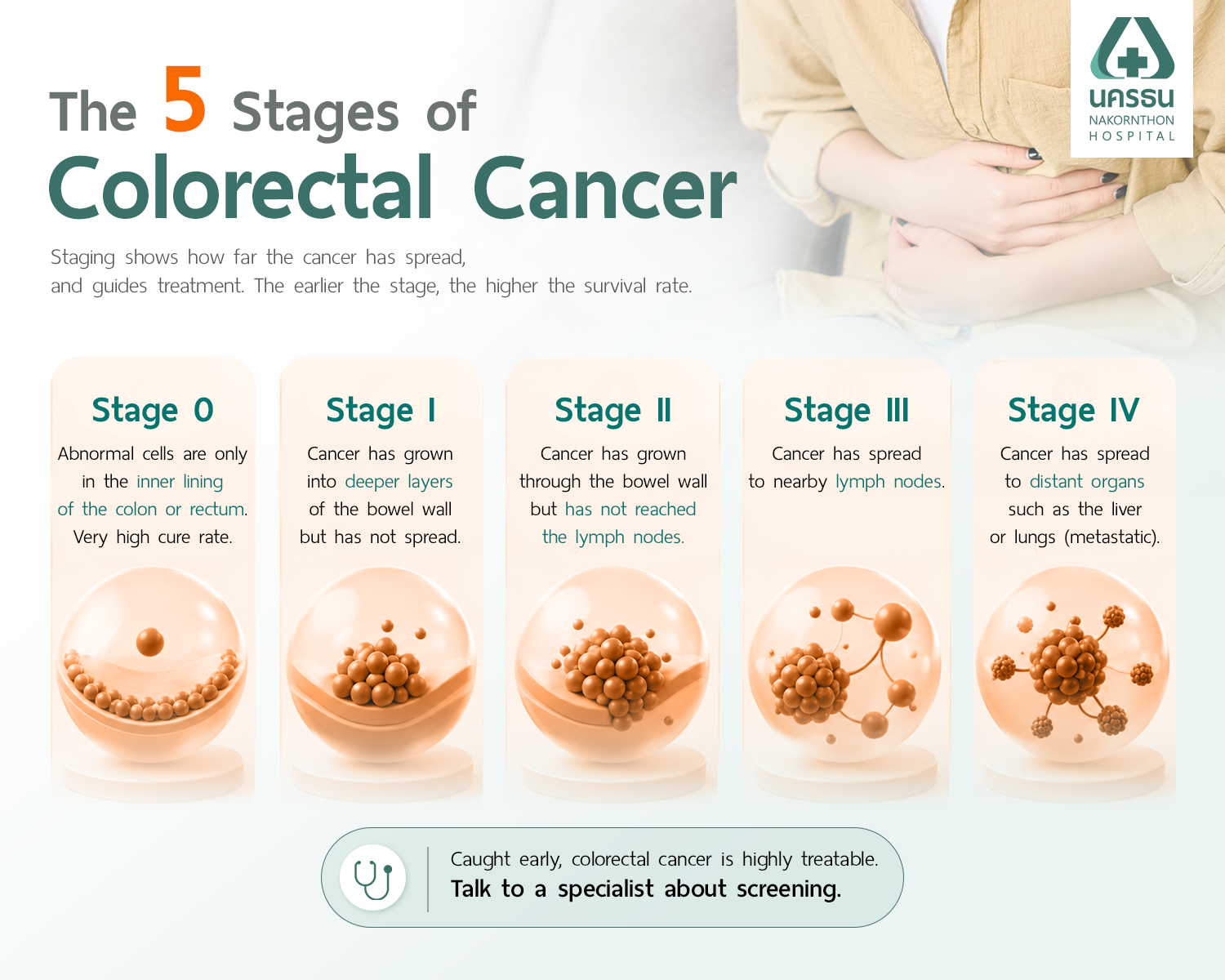
Survival rates are very high in the early stages, so identifying the disease early via symptom awareness or screening is crucial.
Treatment Options at Nakornthon Hospital

Colorectal cancer calls for proper treatment, and Nakornthon Hospital is equipped to handle cases as a comprehensive cancer center in Bangkok.
We offer several treatment options personalized based on stage, location, and overall health. Our Cancer Center uses a multidisciplinary team, including an oncologist, surgeon, radiologist, pathologist, and specialist nurses, who plan care together.
The main options include:
- Surgery: The primary treatment for early-stage colorectal cancer.
- Chemotherapy: Medication to kill cancer cells, given before or after surgery, or for advanced disease.
- Radiotherapy: High-energy beams to shrink or destroy cancer cells, used more often for rectal cancer.
- Targeted therapy: Newer drugs that focus on specific changes in cancer cells, with fewer side effects than traditional chemotherapy.
- Immunotherapy: Treatment that helps the body's immune system fight certain types of colorectal cancer.
- Palliative and supportive care: For advanced disease, focused on comfort, symptom relief, and quality of life.
Stay Protected Against Colorectal Cancer with Nakornthon Hospital
Colorectal cancer is most beatable when caught early, and getting the best outcome comes from choosing the right place for quality screening and care. The right setting brings specialist expertise, fast diagnosis, and coordinated treatment together to cover all the bases.
At Nakornthon Hospital, we are a cancer specialist hospital in Bangkok that patients can rely on. Beyond initial colon cancer screening in Bangkok, our specialist GI physicians perform colonoscopies and biopsies onsite. If a malignancy is detected, patients are seamlessly referred through our single-campus pathway from the GI Center directly to the Cancer Center, where we offer a comprehensive treatment plan including tumor resection surgeries, chemotherapy, and radiation therapy.
Throughout this journey, our multidisciplinary cancer team meets regularly to tailor each patient's care, managing treatment side effects alongside advanced on-site diagnostics like PET-CT and MRI, all supported by English-speaking medical staff to ensure every patient receives the best possible outcome.
If you've noticed warning signs or you're simply due for a check, visit our cancer center in Bangkok and make an appointment with our specialists at Nakornthon Hospital today.
- Facebook Fanpage: Nakornthon Hospital - International Patient
- LINE Official: @nakornthoninter
- Tel: 02-450-9999 1233
Frequently Asked Questions About Colorectal Cancer Symptoms
-
Q: What are the early warning signs of colorectal cancer?
A: Early-stage colorectal cancer often has no symptoms, which is why screening matters. As it progresses, warning signs include blood in the stool or rectal bleeding, changes in bowel habits lasting more than a few weeks, narrow stools, ongoing abdominal pain or bloating, unexplained tiredness, weight loss without trying, and a feeling that the bowel doesn't empty fully. Any of these lasting more than two weeks should be checked by a doctor.
-
Q: How do I know if I need a colon cancer screening?
A: Screening is generally recommended from the age of 45 for people at average risk. You may need to start earlier if you have a family history of colorectal cancer or polyps, a personal history of inflammatory bowel disease, or an inherited genetic condition such as Lynch syndrome. If you have symptoms like rectal bleeding or persistent bowel changes, see a doctor regardless of your age.
-
Q: Is colorectal cancer curable if caught early?
A: Yes, colorectal cancer has very high survival rates when caught early. Stage 0 and Stage I cancers, where the disease is still confined to the bowel wall, are highly treatable. Polyps can often be removed during a colonoscopy before they ever become cancerous, which is why early detection through screening makes such a significant difference.
-
Q: Is rectal bleeding always a sign of cancer?
A: No, rectal bleeding is often caused by harmless conditions such as hemorrhoids. However, it is also one of the most commonly dismissed symptoms of colorectal cancer because people assume it's hemorrhoids. Bright red or dark, tarry stools that persist, especially alongside other symptoms, should always be evaluated by a doctor.
-
Q: At what age does colorectal cancer risk increase?
A: Risk increases notably after age 45. However, colorectal cancer is no longer just an older person's disease. One in five new diagnoses is now in patients under 55, with rates in adults under 50 rising in Thailand and globally. Age alone should never be a reason to delay seeing a doctor about symptoms

Free Online Consultation

Article of Cancer Center